
GoBoard vs Schluter vs Durock: Best Shower Waterproofing? (Contractor's Take)
By Anton Sergeev, Owner — MHIC #113057
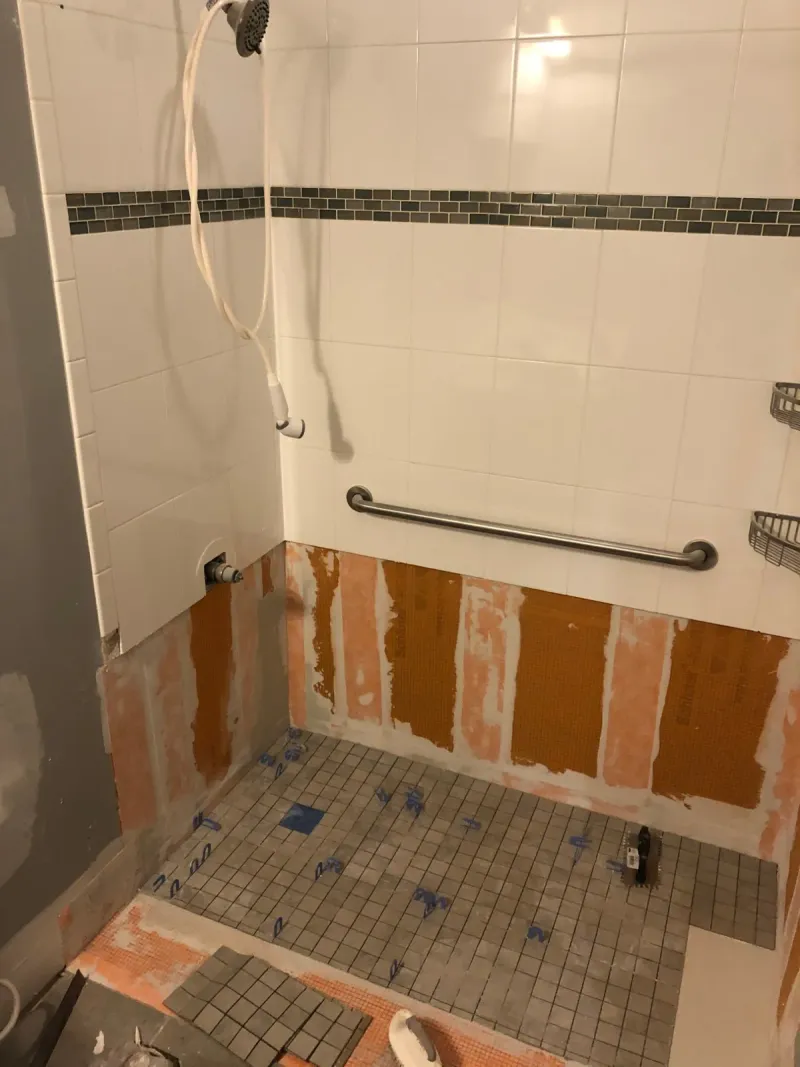
Most shower failures don't start with bad tile. They start behind the tile, where nobody looks and nobody asks questions.
The standard approach in residential shower construction for the last twenty years has been some version of the same thing: screw cement board to the studs, roll or brush on a liquid waterproofing membrane like RedGard, tape the seams, and tile over it. It's cheap. It's familiar. And it's the weakest link in most showers being built right now.
Here's why.
Durock and Liquid Membrane: The Problems Nobody Wants to Talk About
Durock — or HardieBacker, or any cement backer board — is not waterproof. It's water-resistant. There's a difference, and that difference matters when you're building an enclosed wet environment that's going to get hit with water every single day for the next fifteen to twenty years.
The plan is supposed to be: hang the board, tape the seams with alkali-resistant mesh tape and thinset, then apply a liquid membrane like RedGard or Hydroban over the entire surface to create a waterproof barrier. In theory, that works. In practice, it depends entirely on the person holding the roller.
Liquid membranes require a specific mil thickness to perform. RedGard needs to go on thick enough that it dries to a solid, uniform pink — no light spots, no thin areas, no pinholes. That means two full coats minimum, applied evenly, with proper dry time between coats. Every seam taped. Every screw head covered. Every corner treated with membrane fabric or reinforcing tape.
How many crews do you think are actually doing that? On every shower? On a Tuesday afternoon when they're behind schedule on three other jobs?
This is the problem. The system depends on perfect execution with zero verification. There's no way to inspect coverage once the tile goes up. There's no test. There's no accountability. You're trusting that someone rolled on a paint-like product at the right thickness in every corner, every seam, every penetration — and got it right. Every time.
Then there's the fastener issue. Cement board gets screwed to the studs. Every screw is a penetration through the waterproof plane. The liquid membrane is supposed to bridge those screw heads. If the membrane is thin, if it pulls away from the screw head, if someone drives a screw after the membrane is applied — you have a leak path. A tiny one. The kind that doesn't show up for two years, until the framing behind the shower is rotting and you can smell the mold from the hallway.
And the drain? Durock-based systems don't integrate with the drain. You're relying on the pan liner or the mud bed beneath to handle water that gets past the tile and backer board. There's no engineered connection between the waterproofing on the walls and the waterproofing at the drain. It's two separate systems from two different manufacturers, and you're hoping they meet in the middle.
That's not waterproofing. That's wishful thinking with a roller.
If you're reading this because a shower in your own house is already showing it — loose tile, soft grout, a stain on the ceiling below — every shower PRG rebuilds gets a bonded membrane as standard, not as an upgrade. See bathroom remodeling in Anne Arundel County or in Howard County, or call 443-856-5379 for a free estimate.
The Contractors Who Skip the Membrane Entirely
Here's the part that should scare you.
A lot of contractors hang Durock in a shower and go straight to tile. No RedGard. No liquid membrane. No waterproofing at all beyond the cement board itself. They've been doing it that way for years, and in their mind, it works because nobody's called them back yet.
Cement board won't rot like drywall. That's true. But it also won't stop water. Water passes through cement board. It wicks through the seams. It follows the screws into the studs. Given enough time, it saturates the framing, feeds mold colonies behind the wall, and destroys the structure from the inside out.
The reason these contractors get away with it is timing. Mold and moisture damage behind a shower don't announce themselves on day one. They announce themselves in year three, or year five, or when the next homeowner decides to renovate and opens the wall to find black mold on every stud.
By then, the original contractor is long gone. Nobody connects the dots. The homeowner just thinks they have a mold problem. They don't realize they have a waterproofing problem that was built into the shower from the start.
This is the quiet failure mode of residential construction. It happens in thousands of bathrooms every year, and nobody tracks it because by the time it surfaces, the trail is cold.
The Traditional Mud Bed: Respect Where It's Due
Before backer board existed, showers were built with a mortar bed — a thick layer of sand-and-cement mix floated over a hot-mopped or sheet membrane pan, with wire lath on the walls to hold the mud in place. A good mud bed shower, built by someone who knew what they were doing, could last fifty years.
The waterproofing in a traditional shower was the pan liner — a sheet of CPE or PVC membrane — set beneath the mortar bed on the floor, with the curb wrapped and the liner running up the walls behind the lath. Water that made it through the tile and mortar would hit the liner, flow to the weep holes in the drain, and exit. The system assumed water would get in. It just gave it a controlled path out.
This method works. It's proven. But it's a dying skill. A proper mud bed takes time, experience, and a feel for the material that you don't get from watching a YouTube video. The number of tile setters who can float a true mud bed is shrinking every year. Most tile guys under forty have never done one. The few who can do it well charge accordingly, and they should.
If you find a tile setter who still builds traditional mud bed showers and does it right, that person is a craftsman. But for most residential projects, the industry has moved on — and for good reason.
Modern Bonded Waterproofing Systems: Engineered, Not Guessed
This is where the conversation should be.
Systems like Schluter KERDI-BOARD, Wedi, Laticrete Hydro Ban Board, and GoBoard represent a fundamentally different approach to shower waterproofing. These aren't patchwork assemblies of products from three different manufacturers. They're integrated systems where the substrate is the waterproof membrane.
Schluter KERDI-BOARD is a rigid foam panel with a waterproof fleece laminated to both faces. You don't need cement board. You don't need a separate membrane. The board itself is the waterproofing. Seams get sealed with KERDI-BAND. The drain — the Schluter KERDI-DRAIN — connects mechanically to the wall membrane through the same fleece-to-fleece bond. Wall to floor to drain, it's one continuous waterproof envelope from one manufacturer, tested and warranted as a system.
Wedi is another foam-core panel system — 100% waterproof, rigid, and sealed at the joints with Wedi's own sealant rather than fabric banding. The panels are dense and stable, which makes them easy to tile directly. Installation is fast because you're not waiting on thinset to cure at every seam. It's a premium product with a premium price tag, but the labor savings and the quality of the finished system justify it on the right project.
GoBoard is similar — a waterproof, vapor-tight tile backer with a closed-cell foam core and a polymer-modified cementitious coating. It's lightweight, easy to cut, and the waterproofing is built into the panel. No painting, no rolling, no guessing.
Laticrete Hydro Ban Board takes the same approach with their own chemistry. The board is the membrane.
The advantage of these systems isn't just that they're waterproof. It's that the waterproofing is verifiable. You can see the seam tape. You can inspect the connections. You can confirm that every joint is sealed before a single tile goes up. There's no hidden layer of paint that may or may not be the right thickness. The system is visual, inspectable, and engineered to work as a unit.
Are these systems more expensive per square foot than a sheet of Durock and a bucket of RedGard? Yes. The material cost is higher. But the labor is often comparable or lower, because you're eliminating steps — no taping and mudding seams, no membrane application, no waiting for dry time between coats. And the performance gap isn't close. You're comparing an engineered waterproof system to a best-effort paint job.
For a shower that's going to be used every day for the next two decades, the material cost difference is noise. The callback cost of a failed shower — tear-out, mold remediation, framing repair, new tile — makes the upfront savings on backer board look absurd.
Why Contractors Still Default to Durock and RedGard
Habit. That's the real answer.
Durock is what they learned on. It's what the supply house stocks. It's what the crew knows how to install. Switching to a bonded waterproofing system means learning a new installation method, stocking different materials, and potentially pricing jobs differently. For a crew that's been doing it the same way for fifteen years, that's friction.
There's also the cost perception. A sheet of Durock is cheap. A bucket of RedGard is cheap. Schluter panels cost more per sheet. On a bid sheet, the guy using Durock looks like the better deal. What doesn't show up on the bid sheet is the labor time for proper membrane application, the risk profile of the finished product, or the warranty coverage — which, with a patchwork system, is effectively zero because no single manufacturer owns the outcome.
And then there's the line that kills more showers than anything: "It's always worked." That statement is unverifiable. The contractor who says that has never opened a ten-year-old shower they built and inspected what's behind the tile. They don't know if it worked. They know nobody called them. Those aren't the same thing.
What PRG Does and Why
We use bonded waterproofing systems. Schluter KERDI-BOARD is our primary method for new shower construction. We've also installed Wedi systems — same concept, different manufacturer, equally solid when installed correctly. When the job calls for it, we'll use GoBoard or Laticrete Hydro Ban Board. The right system for the right application.
We don't use Durock with liquid membrane in showers. Not because it can't work in ideal conditions, but because we don't build showers for ideal conditions. We build them for the real world, where the shower gets used twice a day, where the exhaust fan doesn't always run, where the grout will crack eventually and the system behind the tile has to handle it.
Every seam gets taped with the manufacturer's band material. Every corner gets a pre-formed corner piece or properly folded band. The drain integrates mechanically with the wall membrane. Wall to floor to curb to drain — one continuous waterproof envelope, one manufacturer, one warranty.
We can show you the system before the tile goes on. You can see every joint. You can touch every seal. That's the difference between a system you can verify and one you have to take on faith.
If your contractor is hanging Durock in your shower and going straight to thinset and tile with no waterproofing step in between — stop and ask why. That's the moment. Because once the tile is up, nobody will ever know what's behind it. You won't. The next owner won't. The mold will.
PRG Home Improvement LLC builds showers the right way in Anne Arundel and Howard Counties, Maryland. MHIC #113057. Licensed, bonded, and insured. 25 five-star Google reviews. For what a properly waterproofed shower runs as part of a full project, see my Maryland bathroom remodel cost guide. If you're planning a bathroom remodel and want it done once, contact us for an estimate. We're a licensed bathroom remodeler in Maryland and handle bathroom remodeling in Gambrills, bathroom remodeling in Crofton, and surrounding communities.
Frequently Asked Questions
Is Durock waterproof?
No. Durock is a cement backer board. It's water-resistant, meaning it won't break down or rot when exposed to moisture the way drywall will. But it does not stop water from passing through it. Water migrates through cement board, through seams, and along fastener penetrations. Without a separate waterproofing membrane applied over the surface, Durock provides zero waterproofing in a shower installation.
Is RedGard enough for a shower?
RedGard can work as a shower waterproofing membrane — if it's applied at the correct thickness, in multiple coats, over properly taped seams, with reinforcing fabric at changes of plane, and with adequate dry time between coats. The problem is that there's no practical way to verify any of that once tile is installed. The system is only as good as the application, and the application is invisible the moment the first tile goes on. Bonded waterproofing systems like Schluter KERDI-BOARD eliminate this variable entirely because the waterproofing is built into the substrate.
What is the best shower waterproofing system?
For residential shower construction, bonded waterproofing systems are the current best practice (TCNA Handbook). Schluter KERDI-BOARD, Wedi, GoBoard, and Laticrete Hydro Ban Board are the leading options. These systems integrate the waterproof membrane directly into the backer panel, so there's no separate membrane step to get wrong. They also offer manufacturer-backed warranties when installed as a complete system with matching components — something a patchwork Durock-plus-liquid-membrane approach cannot provide.
Does GoBoard need RedGard?
No. GoBoard is waterproof on its own — the closed-cell foam core and coated faces are the membrane. What it does need is properly sealed joints and fastener penetrations, using GoBoard Sealant or a manufacturer-approved sealant, before tile goes on. Rolling RedGard over GoBoard adds cost and a second failure mode without adding protection — and mixing manufacturers can void the system warranty. If a contractor proposes RedGard over GoBoard, they're treating it like cement board, which misses the point of buying it.
Wedi vs KERDI-BOARD vs GoBoard: which should I choose?
All three are bonded waterproof board systems, and any of them installed to manufacturer spec beats cement board with a liquid membrane. The practical differences: Schluter KERDI-BOARD has the deepest ecosystem — KERDI-DRAIN, pre-formed niches and curbs, and the most robust drain-to-wall integration. Wedi panels are the densest and most rigid, with sealant-based joints that make for the fastest verified install; it's the premium-priced option. GoBoard is the lightest, easiest to cut, and usually the most affordable of the three. Laticrete Hydro Ban Board competes in the same class. I install all of them and pick per job — the system matters less than complete, inspectable seam treatment and a drain that integrates with the walls.
Do I need a membrane behind shower tile?
Yes. Tile and grout are not waterproof. Water will get behind your tile — through grout joints, through cracks, through unsealed penetrations at fixtures and niches. Without a waterproof membrane behind the tile, that water enters the wall cavity, contacts the framing, and creates the conditions for mold growth and structural damage. The membrane is the actual waterproofing. The tile is the wear surface. They are not the same thing, and skipping the membrane is the single most common cause of long-term shower failure.
How does Schluter compare to RedGard?
They solve the same problem in fundamentally different ways. RedGard is a liquid-applied membrane that goes over cement backer board. Its performance depends entirely on application quality — thickness, coverage, and seam treatment — none of which can be verified after tiling. Schluter KERDI-BOARD is a rigid panel with a factory-applied waterproof fleece. The waterproofing is manufactured in, not painted on. Wedi takes a similar approach with rigid foam panels and a sealant-based joint system. With either, seams are inspectable before tiling, and the drain integrates mechanically into the system. Schluter and Wedi both provide system warranties when their products are used together. RedGard, applied over another manufacturer's backer board, with a third manufacturer's drain, carries no system-level warranty. For performance, verifiability, and accountability, the engineered systems win.